
Why Transactional Data Gives Direct Mail a Powerful Acquisition Advantage
Marketers have gotten good at chasing people who already know us.
Someone visits the website. Looks at a product. Abandons a cart. Clicks an ad. Signs up for email. And suddenly, an entire marketing ecosystem kicks into gear trying to get that person to come back and buy. There’s nothing wrong with that. Retargeting works, and it absolutely belongs in the marketing mix.
But there’s also an obvious limitation: retargeting can only reach people who have already raised their hand. If most of your acquisition strategy depends on people who have already visited, clicked, browsed or engaged with your brand, eventually you run into the same problem: the audience has a ceiling.
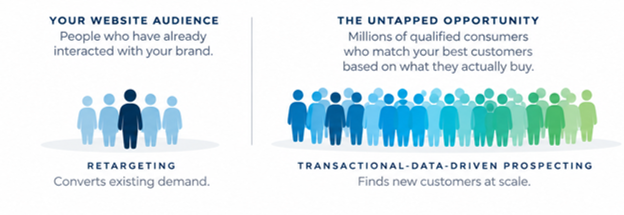
The bigger growth opportunity is outside that audience. It’s the millions of consumers who may look a lot like your best customers but have never visited your website, clicked one of your ads or even heard of your brand.
And that changes the acquisition conversation.
Conversion Is Not the Same as Acquisition
Digital retargeting—and even digital-to-print retargeting—can be very effective at moving an interested consumer closer to making a purchase. But sending that same consumer a piece of mail instead of another digital ad doesn’t suddenly make it true prospecting.
You’re still starting with someone who gave you a signal: they visited your site, looked at a product, abandoned a cart, subscribed to something or interacted with the brand in some other way.
That’s why I think marketers need to separate two questions:
- Retargeting asks: How do we get more people who already know us to convert?
- Acquisition asks: How do we find the next large group of people who are likely to buy from us?
Both are important. They just solve different problems.
If you want to improve conversion, retargeting is a great tool. If you want to materially grow your customer file, at some point you must reach beyond the people already inside your ecosystem.
Eventually, Every Audience Hits a Ceiling
I like to think about acquisition as a series of ponds. Your website visitors are one pond. Your broader engaged audience is another. Digital-to-print retargeting can make that pond a little bigger by identifying more people and reaching them offline.
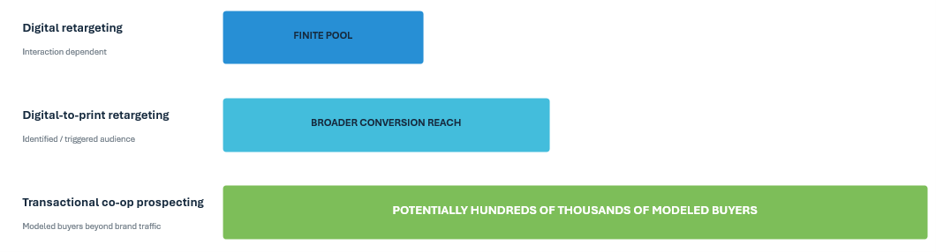
But you’re still fishing in essentially the same water.
Eventually, you’ve reached the highest-intent people multiple times. Frequency goes up, but the amount of truly incremental opportunity starts going down. At that point, fishing hard isn’t necessarily the answer. You need another pond.
And that’s where transactional co-op databases becomes so interesting.
What People Buy Can Be More Powerful Than What They Browse
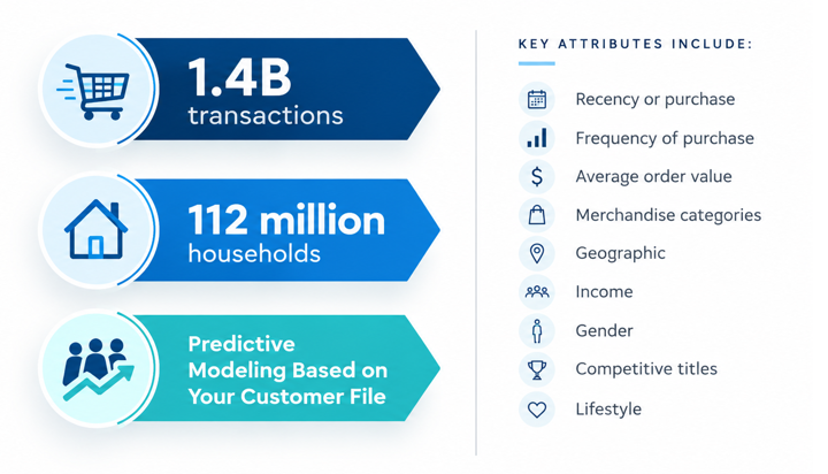
When you’re trying to find new customers, there’s a powerful signal available to marketers: what people actually buy. Transactional co-op databases let us move beyond website behavior and build prospecting audiences based on real purchase behavior.
We can look at things like recency, frequency, average order value, merchandise categories, geography, income, competitive purchases and other attributes. Then we can use those signals to identify consumers who behave like the customers already performing well for the brand.
- That lets us stop asking only: “Who interacted with us?”
- And start asking: “Who behaves like our best customers?”
That may sound like a small distinction, but from an acquisition standpoint, it’s a very big one.
The Real Advantage Is Scale
This is where direct mail becomes particularly interesting as an acquisition channel.
We’re simply not looking for another way to reach somebody who visited the website yesterday. We’re using transactional intelligence to identify potentially large groups of consumers who demonstrate the characteristics of likely buyers—even though they may have no previous relationship with the brand.
That’s important because sustainable growth isn’t only a conversion problem. It’s an audience problem.
You can keep optimizing landing pages, retargeting campaigns, email flows and conversion rates—and you should. Those improvements matter. But ultimately, you’re getting more performance out of people who are already within reach. True prospecting expands who is within reach.
That’s the bigger opportunity: moving from a relatively limited website audience to a broader retargeting audience, and then into a much larger universe of consumers identified through transactional behavior.
Direct Mail and Digital Shouldn’t Be Either/Or Decision
This isn’t an argument to stop digital acquisition or retargeting. Not even close.
Retargeting is good at what it’s designed to do: capture and convert demand that already exists. I think the better approach is to let each channel do what it does best: Retargeting converts existing demand. Prospecting creates new opportunities.
Direct mail can help bridge that gap because it allows brands to reach consumers based on demonstrated buying behavior—without waiting for those consumers to find you first.
And getting into the mail doesn’t have to mean a six-month timeline or a massive creative and production budget. Today’s direct mail programs can be built to fit the objective, the audience and the budget. Tri-folds, double-gate mailers, digest-size pieces and full catalogs all offer different ways to tell the brand story, showcase merchandise and drive response. Many can be developed and produced relatively quickly and efficiently without breaking the bank.
The key is choosing the right format for the opportunity. You don’t always need a 48-page catalog to acquire a new customer. Sometimes a well-targeted audience, a compelling offer and a smart eight-panel mailer are enough to introduce the brand and generate that first purchase. Start smart, test, measure incrementality—and scale what works.
Stop Asking Who Visited. Start Asking Who Should.
For years, marketers have invested enormous amounts of time and money understanding what consumers they once enter our digital ecosystem. Maybe it’s time we spent just as much energy thinking about the people who haven’t entered it yet.
Your next great customer may never have visited your website.
They may never have clicked your ad.
They may not even know your company exists.
But their purchasing behavior may already be telling you that they look remarkably similar to some of your best customers. And that’s really the opportunity. Growth isn’t just about converting more of the audience you already have.
It’s about finding the audience you don’t have yet.