
In our last post, we talked about protecting what’s working, tightening segmentation, and using this time to test smarter rather than react harder. We also mentioned that the next step is identifying cost-efficiency opportunities that don’t compromise performance.
Because when pressure builds, “cost efficiency” can quickly start to mean broad cuts, smaller budgets, fewer drops, or pulling back circulation faster than the data supports. That may feel decisive in the moment, but in direct mail, the cheapest move is not always the most efficient one.
So where should marketers look first?
- Start With the Cost Drivers You Can Actually Control
When marketers think about print savings, the first instinct is often to reduce circulation. While that can provide immediate financial relief, it’s usually not the best place to start, at least not with aggressive cuts. In most cases, there are multiple ways to reduce costs before making major changes to circulation levels, including:
- Testing different formats
- Slight reduction in page count
- Paper and production specifications
- Contact strategy and cadence
- Prospecting mix
- Reactivation depth
The goal is not simply to mail less. The goal is to mail more efficiently.
- Page Count Is Often One of the Cleanest Testing Opportunities
One of the most practical places to look for efficiency is page count.
Many brands operate with legacy assumptions about how many pages are “needed” to drive performance. But when those assumptions are challenged through controlled testing, the results are often more flexible than expected.
In many cases, a modest reduction in page count does not lead to a proportional drop in demand. Why? Because not every audience responds to the book in the same way. Some customers are buying based on brand familiarity, merchandising relevance, or offer strength.
That doesn’t mean page count never matters. It absolutely does. But it does mean brands should test to find the true performance threshold instead of continuing to pay for pages that may not be doing enough work.
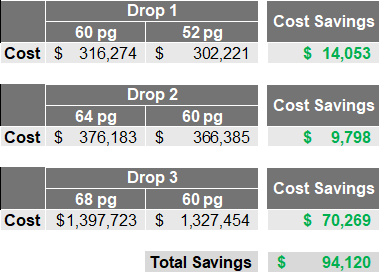
One example of the cost impact of reducing page count is below. This retailer was mailing a relatively large book that exceeded the USPS 4 oz. threshold. By reducing two to three spreads across three drops, this brand was able to save nearly $100K.
- Format Testing Can Unlock Savings Faster Than Most Teams Expect
Format is another underused efficiency lever.
During economic uncertainty, brands sometimes assume the only safe move is to stay exactly where they are. But format testing can show that a more efficient print piece can still perform well, especially when paired with strong merchandising and a disciplined audience strategy.
The purpose of a format test is not to cheapen the brand. It’s to understand how much investment each audience actually requires.
For some segments, a smaller format may preserve most of the conversion while reducing print and postage costs. For others, the larger format may still be the right choice. The answer is rarely one-size-fits-all, but that’s why we test.
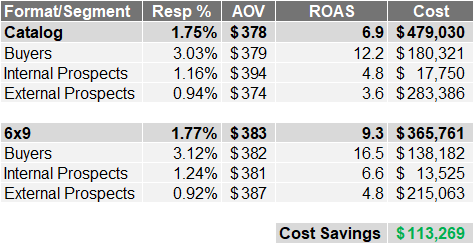
In the case study below, this retailer had historically mailed an upright catalog. By introducing a 6” x 9” digest, the brand was able to save $113K while maintaining performance comparable to the more expensive upright format.
Cost efficiency in print is not about cutting until the budget feels safer. It’s about identifying where costs can come out without taking performance with it.
In a soft market, that kind of efficiency is more than prudent. It’s strategic.
Because the brands that win in the back half of the year won’t be the ones that pulled back the fastest. They’ll be the ones that got sharper.